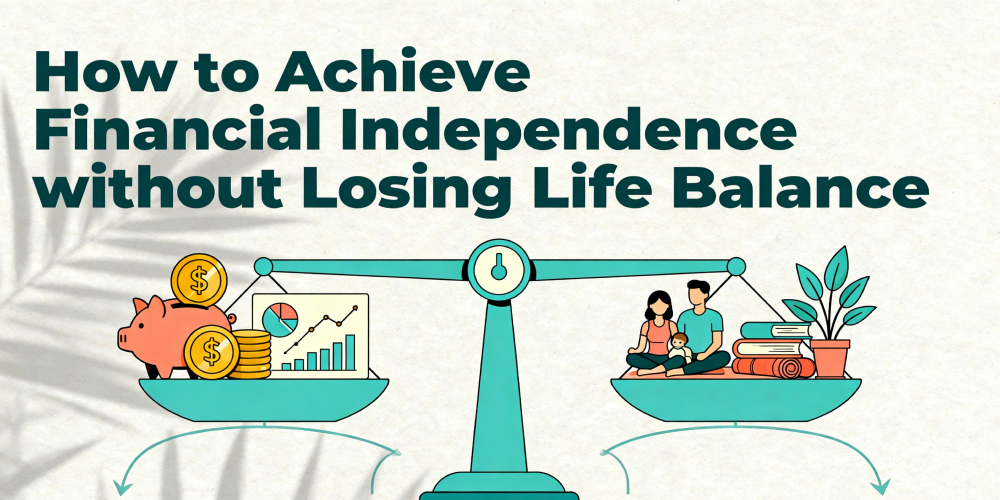
The idea of retiring early sounds exciting.
No salary dependency, no fixed working hours, and the freedom to choose how you spend your time
This aspiration has given rise to the FIRE movement in India — Financial Independence, Retire Early.
However, FIRE is not merely about stopping work early. It is about building a financial life that gives you control, confidence, and choice. To truly achieve FIRE, one must understand the realities of early retirement, not just the theory or popular formulas.
What Is the FIRE Movement in India?
The FIRE movement focuses on achieving financial independence, where your investments generate enough income to support your lifestyle. Once this stage is reached, work becomes optional rather than compulsory.
In the Indian context, FIRE comes with unique challenges:
- Rising inflation
- Healthcare costs
- Family responsibilities
- Longer retirement duration
Therefore, early retirement planning in India requires more thoughtful and personalised planning than generic global models.
What Does Early Retirement Really Mean?
Early retirement does not mean stopping work forever.
It means reaching a stage where your investments can fund your lifestyle, giving you the freedom to:
- Continue working by choice
- Slow down professionally
- Change careers
- Pursue meaningful or flexible work
The challenge is simple to state but difficult to execute:
Your capital must last longer than usual while supporting a full and active life.
This is where Life Planning becomes central to FIRE.
How Much Corpus Is Required for Early Retirement in India?
This is the most common — and most misunderstood — FIRE question.
There is no single FIRE number that works for everyone. The required retirement corpus depends on:
- Lifestyle expectations
- Inflation
- Healthcare costs
- Longevity
- Future responsibilities
- Investment return assumptions
Since early retirement means your investments must replace income for a longer period, even small planning mistakes can have a large long-term impact.
That is why FIRE cannot be planned using generic formulas alone.
Retiring at 40 vs Retiring at 50 – A Practical Comparison
Let’s understand this with an example.
Assumptions :
- Current age: 30
- Current annual expenses: ₹6,00,000
- Inflation: 6%
- Expected post-retirement returns: 8%
Scenario 1: Retiring at 40
- Annual expenses at age 40 ≈ ₹10.74 lakh
- Using the commonly referenced 25x rule:
- Required corpus ≈ ₹2.7 crore
However, your retirement period may last 40–45 years, making this plan more sensitive to:
- Market volatility
- Healthcare inflation
- Unexpected life events
Scenario 2: Retiring at 50
- Annual expenses at age 50 ≈ ₹19.24 lakh
- Required corpus ≈ ₹4.81 crore
Although the corpus appears higher, this scenario benefits from:
- 10 additional years of compounding
- Shorter withdrawal duration
- Lower long-term risk
For many individuals, retiring at 50 provides better financial stability with flexibility, while still maintaining a FIRE mindset.
Why FIRE Is More than Just Numbers
Most FIRE-related content online focuses heavily on:
- Corpus calculations
- Withdrawal rates
- Expense multiples
While these are important, numbers alone cannot create freedom.
Without clarity on life priorities, FIRE becomes a mathematical exercise.
With Life Planning, FIRE becomes a directional tool.
Why Life Planning Is Essential to Achieve FIRE
At its core, FIRE is not about money.
It is about life choices.
A Life Planning approach begins by answering:
- What kind of life do you want to live?
- What does financial freedom mean to you?
- What responsibilities do you want to honour?
- What gives you fulfilment?
Only after these answers are clear does financial planning — and FIRE — start making sense.
Why Prioritisation of Goals is Critical
We all have multiple goals but limited resources.
Life Planning helps you decide:
- What comes first
- What can wait
- What trade-offs are acceptable
For example:
- One person may prioritise family time and work-life balance, even if it delays FIRE.
- Another may choose aggressive saving and longer working hours to achieve financial independence earlier.
Both choices are valid.
What matters is that the decisions are intentional and aligned with personal values.
Common Mistakes People Make While Planning FIRE in India
Many individuals struggle to achieve FIRE due to:
- Relying solely on the 25x rule
- Ignoring healthcare and lifestyle inflation
- Assuming unrealistic investment returns
- Not accounting for emergencies or contingencies
- Chasing early retirement without clarity on life goals
These mistakes often lead to stress rather than freedom.
Final Thought
FIRE is not about escaping work early.
It is about reaching a stage where money no longer controls your life decisions.
Even if you retire at 50 instead of 40, planning with a FIRE mindset provides clarity, confidence, and peace of mind.
And that — not early retirement alone — is the true goal of financial independence.
Need Help With Your FIRE Planning?
If you want clarity on whether your current investments and savings can truly support your FIRE goals, our professionals are here to help.
Get a 100% FREE Portfolio Audit
Our experts will review your existing investments, assess alignment with your life goals, and help you understand whether you are on the right path toward financial independence.
Frequently Asked Questions on FIRE in India
Yes, but it requires disciplined planning, realistic assumptions, and alignment with life goals.
There is no fixed number. It depends on lifestyle, retirement age, inflation, healthcare costs, and longevity.
No. FIRE gives you the freedom to work by choice, not compulsion.
For many, retiring at 50 offers better financial stability due to longer accumulation and a shorter retirement period.